Munachimso E. Nwagbara · Voice of I AM Longform

Who Is God?

After rain, a tree reveals more of itself. The bark goes dark. Water gathers at the edge of a leaf and drops into the soil. Small channels form around the roots. A fallen leaf softens where it touches the ground.

The tree is visible. Most of what sustains it is not. It did not make the rain, choose the soil, arrange the light, or decide what would grow beside it. It receives conditions it did not create and changes within them.

People gather around the tree from different directions. One has inherited a story about it. Another has measured it. Another has been warned not to touch it. Someone remembers when it was small; someone else believes it has always stood there. One is interested in its fruit, another in the shadow it casts. They begin to speak. At first each reports what they have seen. Then the reports harden. The person who has seen the roots says the others do not understand the tree. The person who has eaten its fruit says roots matter less than harvest. The person who remembers the storm says the tree is dangerous. The person who has measured its height says measurement is the only reliable language.

A position becomes an identity. An identity becomes an authority. An authority begins to sound like the landscape itself.

Before you ask who God is, you have already been placed somewhere in the circle — a family, a language, a region, a religious tradition, a history, an account of the dead, an explanation for suffering, an idea of what a good person should fear or obey or protect. No one begins from nowhere. We begin from somewhere, and somewhere is not everywhere.

This is a book about the question. It is not a proof. It is not a polemic. It will not ask you to accept its conclusion before you have seen the path. It will not treat belief as stupidity or doubt as courage by default. It will not use science to humiliate wonder, or wonder to avoid evidence. It will not polish away disagreement to make any tradition easier to praise or condemn. Where the author does not know, he will try not to decorate the emptiness.
31chapters
~103kwords · ~520pp
5working metaphors
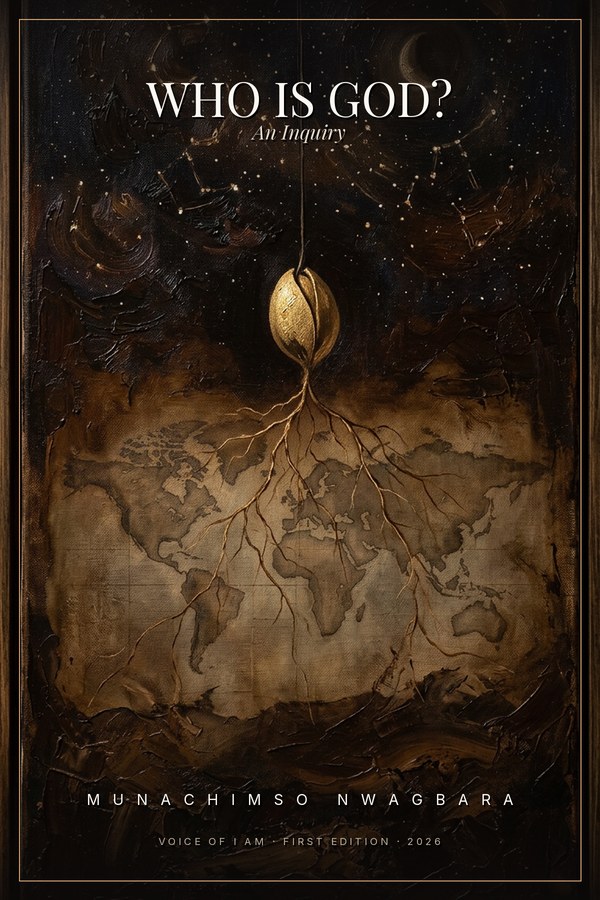
VOI-L09 cover art
Munachimso E. Nwagbara
₦18,000 one-time
Get the book →

EPUB + PDF · lifetime updates · 30-day refund

✦ Pass it on:
If you are reading this now, you are alive. The sentence arrives before the argument. You do not need to make this fact beautiful before it becomes true. Life is occurring while the largest questions remain unanswered. Hunger, grief, work and affection do not wait for a theory of existence. Nor does an answer, if one is found, remove the need to decide what that answer demands from a person. — Prologue, If You Are Reading This Now
I will not invent a personal scene to make an argument more persuasive. Where I do not know, I will try not to decorate the emptiness. Where a source is contested, I will not make confidence do the work of evidence. You may disagree with me. You may remain a believer, an atheist, an agnostic, a traditionalist, a seeker, or a person who does not want a name for your position. The book will not ask you to surrender your judgement. It will ask you to use it. — Prologue, The Contract With the Reader
The central disciplines

Five distinctions kept open
throughout the whole book.

A single chapter is enough to teach you what the rest of the book is doing. The lightning chapter lays down the discipline that returns in nearly every chapter after it:

Reality is not identical to a description of reality. A bolt of lightning is not an argument for God merely because it is powerful. It is not an argument against God merely because electricity can describe it. It is a place where explanation has to be allowed to do its own work. Let a physical explanation complete its work before asking it to carry a metaphysical conclusion.

The book makes five distinctions and refuses to collapse them: reality ≠ description; experience ≠ proof; belief ≠ knowledge; unknown mechanism ≠ ultimate explanation; a mystery ≠ an ignorance. Each distinction is made carefully, because both sides have a history of using the collapse as a weapon.

If any of these are you

This book was written for you.

You are tired of being told which side to take.

  • You grew up in the church and the question has not gone away — but neither have the people who told you to stop asking.
  • You left the church and you have been reading books that treat belief as a solved error, and you know in your body that this account is too thin.
  • You are an Igbo person for whom Chukwu, Ala, chi, and the ancestors were part of the air you breathed, and you have never found a book that names those things without either romanticising them or dismissing them.
  • You are a scientist or an engineer and you have grown tired of people using science to answer questions it does not address, and equally tired of religious people pretending science has done nothing.
  • You have stood beside a hospital bed and felt both the insufficiency of a medical explanation and the dishonesty of a quick spiritual one.
  • You do not want to be argued into a position; you want to be shown a path you can walk with your judgement intact.
  • You are suspicious of books about God that arrive already certain — on either side.

What it costs when we collapse the distinctions.

People do not only lose arguments when they mix up mechanism with meaning. They lose things that matter:

People are told their suffering is punishment, because a community has confused explanation with moral verdict. Children are denied medicine because their guardians mistook a spiritual interpretation for a physical mechanism. Young people leave their traditions entirely because the only version offered to them was a version too fragile to survive questions. Atheists become mirror-fundamentalists — certain they have outgrown superstition — and replicate the same coercive posture they objected to in the pulpit. Traditions get polished into a single voice, erasing internal disagreement and making it impossible for insiders to criticise or outsiders to see them honestly.
Structure

Five working metaphors,
thirty-one chapters.

PrologueThe Land Beneath the QuestionIf you are reading this now. The ground and the tree. The circle. The contract with the reader. Five working definitions: Land, Ground, Tree, Roots, Circle, Seed.
Ch 1–4Position & NameThe position before the question. Different sides of the tree. The name is not the thing. The first meat: Chukwu as inherited intimacy. Look, distinguish, test, revise, continue.
Ch 5–7Mechanism & GroundLightning, disease, eclipse — what mechanism can and cannot answer. God of the gaps. Three levels of explanation. The contingent house. Necessary being and the honest boundary.
Ch 8–10Tradition & TextsThe numbers. Return to the opening scene. Nri, Ala, chi, alusi and ancestors — the Igbo landscape named with its internal disagreements intact. Many ways of receiving.
Ch 11–19Texts, History, SufferingAfter the God-concept. What the texts say. One text, different moral readings. The twin story. The problem of evil returns. Warmth and cold. Ordinary religious cooperation. Many trees. The same morning.
Ch 20–28Persons, Receiving, ResponsibilityThe question returns to the human. The impossible object. Swimming. What we receive. From land to tree to seed. The claim. If you are reading this now (return). The reader's position. The sentence.
Ch 29–31Living With the QuestionI. The word "later." Inventory of inheritance. The bank alert that tests faith. Prayer when you are not sure who is listening. What to do with a question you cannot settle.
MethodEvidence map includedEach claim graded for evidential strength: experience, history, tradition, mechanism, inference, testimony. Where there is disagreement, the disagreement stays visible.
This is not apologetics. It is not anti-religion. It is not "all paths lead up the same mountain." The author refuses each of these ready positions in turn. He will not argue you into theism and he will not argue you out of it. He will not flatten religious traditions into a single perennial wisdom. He will not treat science as a new priesthood. He will not decorate ignorance with the word "mystery." What he offers instead is slower and more uncomfortable: a set of distinctions and a method for using them, applied honestly to the claims of Christianity, of Igbo traditional thought, of scientific materialism, and of the varieties of doubt, with no position receiving immunity because it is familiar.
Get it now

Who Is God?

31 chapters · Evidence Map · ~103,000 words · EPUB + PDF

₦18,000 one-time

The question returns to the one asking it.

  • The complete book. Prologue, 31 chapters, method note, evidence map, closing inventory. EPUB + PDF. ~520 pages.
  • The Contract with the Reader on page one — six specific commitments the author makes about how he will and will not argue.
  • Igbo thought presented with internal disagreement intact. Nri, Ala, chi, alusi, ancestors — not romanticised, not flattened, not reduced to a foil for Christianity.
  • Concrete test cases: lightning, germ theory, Semmelweis and handwashing, the twin story, the bank alert that tests faith, the hospital bed where mechanism is not enough.
  • The five distinctions maintained throughout. No smuggled conclusions. No rhetoric doing the work of evidence.
  • Lifetime updates. Every new edition free.
  • 30-day refund. Read the prologue and Chapters 1–5. If the method does not earn your trust by then, email us. Full refund. The author would rather you not read him under coercion.

Pay securely with Paystack · card, transfer, USSD · instant download

About the author

He is not writing from a settled position.

M

Munachimso E. Nwagbara writes from Mgbowo, Enugu. He is the same man who wrote Books One through Eight. He was raised in a Christian household in Igboland; he sat for years with the questions this book holds. He is not a pastor, not an apologist, not a professional atheist debater.

He will tell you plainly that he has, at different times, believed with conviction, doubted with fury, and sat in silence for long stretches where none of the available vocabulary fit. The book is written from inside that history, not from a position outside it. If he arrives at any conclusion it is a narrow one: that the question is worth asking carefully, and that most of the available answers have been too easy.

Books One (Watching), Four (Trust), Five (Choose), and Seven (Alibi) are recommended before this one. You cannot ask the question honestly while your mind is unobserved, your trust is un-inspected, your beliefs are held by default, and your alibis are intact.

Questions

The ones before you buy.

Do you conclude that God exists or that God doesn't?

The book does not end in a tidy yes or no. It ends with distinctions held carefully, and with a chapter on what to do with a question you cannot settle. Some readers will land in faith, some in agnosticism, some in atheism, some in a quiet traditional piety. The author's own position is stated plainly when it arrives; the point of the book is not to get you to share it, but to give you a method for arriving honestly at your own.

Is this book for Christians only? For Igbo people only?

No. The central examples draw heavily from Christianity and from Igbo traditional thought because those are the two inheritances the author knows from the inside. But the method applies to any tradition: Islam, secular humanism, New Age spirituality, any inherited framework. Chapter 4's method (look, distinguish, test, revise, continue) is portable.

Do you argue against evolution / against science?

No. Chapter 5 on lightning and germ theory is the clearest signal on this point. Mechanism must be allowed to complete its work. Where science answers a question, the answer must be received. The book argues against the slide from "science explains this mechanism" to "therefore there is no further question to ask" — which is not science, but a metaphysical claim smuggled in under science's authority.

Is this "all religions are the same" universalism?

No. The author explicitly refuses that move in the prologue: "I will not use the tree to prove that all religions share one root." Different traditions make genuinely incompatible claims; to pretend otherwise is a failure of respect. The book insists on treating disagreement as disagreement rather than melting it into harmony.

Is this safe for me to read if I'm a committed believer?

Probably not safe, but it is honest. The author does not set out to destroy faith, but he will not protect fragile faith either — he will ask you to test it. If your faith cannot survive the questions in this book, it was not built on ground that could hold weight. Some readers will find their faith deepened by this; some will leave. The author considers both outcomes acceptable, provided they are arrived at honestly.

How long is it really?

~103,000 words — about 520 pages. Read slowly. One chapter a sitting. Stop when you need to. The book is designed to be argued with. Mark it up. Disagree in the margins.

Is there an answer key or study guide?

The book contains its own evidence map. There is no separate study guide yet; if one is written, it will be sent as a free lifetime update.

What if I am tired of the whole question?

That is a real position and the book respects it. Chapter 31 is about living with a question you cannot settle — which includes the possibility that the honest answer, for a season or a lifetime, is to set the question down and feed the people in front of you. The book does not require you to be preoccupied with God to read it.

Start wherever you are

No one begins from nowhere.

You have already been placed somewhere in the circle. The question is whether you will look at what you are standing on.

Get the book — ₦18,000 →
Who Is God? — ₦18,000
EPUB + PDF · 30-day refund