A 96-page, plain-English plan for salary earners who take home good money and still look at their balance on the 18th wondering where it went. No suffering. No second job. Four words. Ninety days.
Instant PDF download · Pay with card in any country
One page. Ten minutes. The single number that explains why your salary disappears — and what to do next.
Enter your email to get the Audit instantly — we'll also send a copy to your inbox. Before you buy anything, do this. Print it. Use a pen. When you're done, you'll know your fixed-cost percentage, your verdict, and the two bills to attack first.
The companion worksheet from the book. Yours instantly.
If you earn $3,000, $5,000, even $15,000 a month and your account is empty by the 18th, you are not bad with money. You are not lazy. You are playing a game that was built to take your money back.
ADP Research's "People at Work 2024" global survey asked more than 38,000 workers across 34 countries whether they were living paycheck to paycheck — fifty-seven percent said yes. A separate analysis of US consumer finances by PYMNTS / LendingClub has repeatedly found that a large share of high earners (including people earning over $100,000/year) also report living paycheck to paycheck. The point isn't the exact number; the point is that when the income is bigger, the system that quietly eats it gets bigger too. ADP source → PYMNTS source →
You've tried the apps. You've tried tracking receipts. You've tried "no spending months" that collapse by Wednesday. They all fail for the same reason: they start with your spending, when the damage was already done before you bought anything you actually wanted.
$14 here, $11 there, a gym you last entered in January. Eleven small charges can be $180 a month — and none of them feel like a decision.
The $22 meal that becomes $34 after delivery, service fee and tip. Card surcharges, ATM fees, foreign transaction fees. Together, a second rent.
Four or five small instalments you agreed to across months and forgot to track. The app calls it flexible. Your bank calls it four more bills.
Rent, transport, insurance, childcare, phone, loans, school fees, family support — all automatic, all invisible, all before you bought anything fun.
Fixed costs are the flood. The small treats are a teaspoon. Any advice that starts with the teaspoon isn't solving your problem — it's just making you feel guilty while you drown.
Every chapter, every worksheet, every script, every template in this book translates back to four words. You can read the whole thing in about two hours, and you'll be using those four words on your next payday.
Subscriptions, fees, renewals, payment plans, delivery charges, bank bites. Find your three biggest leaks and plug them. Most people recover $150–$500 a month here.
On payday, before you touch anything, split into four buckets: Bills (60–70%), Life (20–25%), Buffer (5–10%), Future You (5%). Then Bucket 2 becomes the only number your eyes can see.
$1,000. The size of one ordinary emergency — a phone screen, a car battery, a clinic bill. Built in 30 to 60 days. Stored in a separate account, no card. Money leaves only for an emergency you defined in advance, in calm.
Eight minutes to run the split, check the buckets, move the Buffer, pay one bill ahead. That's the whole recurring system. Willpower runs out by 9pm. Rules don't.
The book walks you through the plan in calendar order. You don't have to be "good with numbers." You just have to be willing to write things down.
The first 30 days are not about cutting back. They're about seeing clearly.
Day 30 gate: you know your number, your leaks are named, and your first buffer is underway — with a target sized to your own income and expenses.
Now that you can see it, rebuild the parts that are bleeding quietly.
Systems survive if they survive real life. This phase builds the habits that hold when things go wrong.
Plain English. No big bank words left unexplained. A worked example ("Maya, $5,000/month, 92% fixed costs") runs through the whole book so you can see every move on a real person before you make it on your own numbers.
Why your money disappears — and why it was never the coffee.
Buckets, not discipline. The split that works on a tired Tuesday.
The 8-minute drill, step by step, with scripts for your bank app.
Five moves that build your first shield in 30–60 days.
Cards, payment plans, family debt — snowball vs. avalanche, the autopay floor, and how to ask for a restructure.
Cutting the big costs — rent, transport, insurance, the things that actually move the percentage.
Helping without drowning — the Giving Cap, the honest "not this month" script.
Shame, anxiety, and the 3am Protocol — when the thinking is more expensive than the spending.
How to stop having the same money fight on the 19th of every month.
The same plan if you're freelance, on commission, gig, or paid in lumps.
What to do when everything costs more than it did three months ago.
Triage for when this month is already on fire. Read first if money finished and payday is far.
Five hours a week, firewall intact — for when the honest maths says you do need to earn more, not just plug leaks.
Word-for-word scripts for negotiating bills, asking for a refund, saying no to family money requests, and the payment-plan restructure conversation.
My Escape Plan worksheet, the 30-Day Challenge, and the 90-Day Escape Calendar you can print and stick on a wall.
Thirty days from now you'll know your number, your biggest leaks will be named, every payday will start with the same split, and a buffer — sized to your income — will be underway. Within ninety days, the 18th stops being a day you dread.
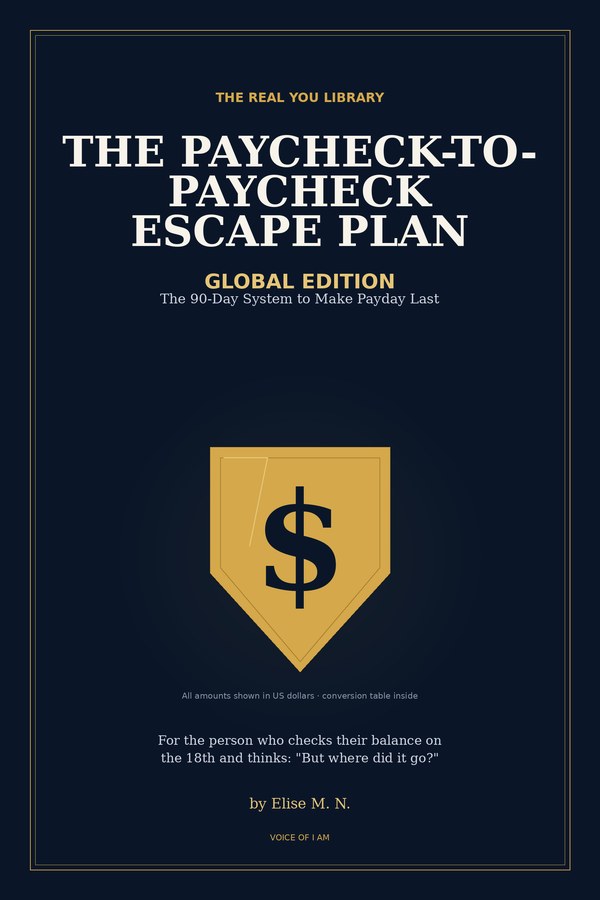
The 90-Day System to Make Payday Last
One-time payment · instant PDF download · works in any currency
Card payments accepted worldwide · Paystack secure checkout
This book is general money education. It is not personal financial advice. For significant decisions — especially around debt, large purchases or bankruptcy — speak to a qualified financial adviser who knows your exact situation. See the full privacy policy.
No. Chapter 1 proves that coffee is not the problem — fixed costs and invisible leaks are. There is no suffering, no "track every penny," no shame. The small joy is explicitly protected.
Yes. The Global Edition uses US dollars as the teaching currency only — every figure is an example for teaching the method, not a rule. There's a currency conversion table at the front covering US$, £, €, ₦, ₹, R (South Africa), KSh (Kenya), ₱ (Philippines), R$ (Brazil), C$, A$ and ¥. The percentages (60–70% bills, 20–25% life, 5–10% buffer, 5% future you) are the part that travels — they don't care what your money is called.
Yes. The plan is about the day money lands, regardless of what day that is. Freelance, commission, gig and irregular-income readers have their own section (Section 10 in the Global Edition). You run the same 8-minute drill every time money hits your account.
You get a 96-page PDF that opens on any phone, tablet, or computer. Right after you pay, you land on a thank-you page with a download button. No waiting for an email, no login required — though you can save the PDF to your device and keep it forever.
No. The core plan doesn't ask you to earn more. It fixes what's already coming in. There's an appendix called The No-Second-Job Income Menu for when the honest maths says you do need more — five hours a week, firewall intact.
Section 5 walks through the debt spiral exit: the debt inventory, snowball vs avalanche, the autopay floor, and how to ask for a restructure. The Last Ten Days triage appendix also covers a bridge plan when this month is already on fire.
Because this is an instantly-delivered digital product, please read the description and FAQ before you buy. If the file doesn't arrive, won't open, or there's a payment issue, message us on WhatsApp and we'll resolve it within 24 hours — including a full refund if we can't fix it. Full policy is on our privacy policy page.
Stop restarting every January, every Monday, every first of the month. Get the plan that works with your real life, not the one you wish you had.